Friday, 28 June 2019

Arable extension


In the past Canons Farm has been the subject of this infrequent blog on a number of occasions,  I have a particular aversion to the agricutural concrete as on the left, that results from the farming techniques used most of the time. 

For the past two years, two fields close to Banstead have not been cultivated (in previous years they seemed to have a problem eliminating Hogweed in crops) and last year saw an explosion of mostly common arable weeds (see Steve Gales post). 


I was expecting all through the year for it to be sprayed but no, everything was allowed to seed and growth of wild flowers has continued into this year! 

Unlike last year when the hot weather tended to slow growth, this years rain has changed all that with Hogweed, Burdock, Weld, Poppies and many other species growing en masse  making a spectacular picture at the moment, see left.


However, for me the star that has dragged out this post is at the eastern end of the field standing proudly on its own, is a plant of Cotton Thistle, Onopordum acanthium, 2m high and not even flowering yet, impressive.  It is not particularly rare but I have not seen it the area for a long time.
 

I have no idea what is going to happen to these fields but it is worth having a look in case the dreaded spray comes out.  Whatever happens hopefully the seed bank will be replenished!

Tuesday, 26 June 2018

Exmoor visit


Just back from a few days on Exmoor, somewhere I have regularly visited for over fifty years and always feel content. 

Exmoor habitats could not be more different from those on the North Downs, with few plant species in common, they range from open upland heather moorland with associated bog to steep-sided wooded valleys.

The moors have a rather limited flora partly because of grazing but the carpets of Tormentil and Heath Bedstraw were spectacular but just starting to flower was that harbinger of high summer, Sheepsbit Jasione montana that has always been a favourite of mine if only because you do not find it on the North Downs!. Bell Heather was just starting to flower but it will be another month or so before that and Ling turn the moors purple. 

 One of our objectives was to try and refind Lesser Twayblade, Neottia cordata at one of its most southerly sites in the British Isles. Sadly the area was not only more overgrown than it used to be but also very dry and heavily trampled by sheep and ponies. No success there but we did manage to find a few Heath Spotted Orchids that hadn't been eaten (right)!  the level of grazing varies enormously from year to year, this year, perhaps because it has been dry for a while it was very noticeable. 

The river valleys are a different proposition, protected, always damp and shaded with a profusion of ferns and mosses as well as flowering plants especially Cow-wheat. A few walks along the Easy Lyn valley produced some of its specialities. Irish Spurge Euphorbia hyberna (left) is common and had almost finished flowering, this valley is one of the few places in England that it grows. Another fine plant Welsh Poppy Meconopsis cambrica (right) also grows here deep in the woods, a common escape just about everywhere, here it is considered native. I must admit it looks right if nothing else.

The biggest surprise for me this visit was however finding a plant I have never seen there or anywhere else in Britain, Bastard Balm
Melittis melissophyllum (left)growing in the same woods, where again it is considered native.

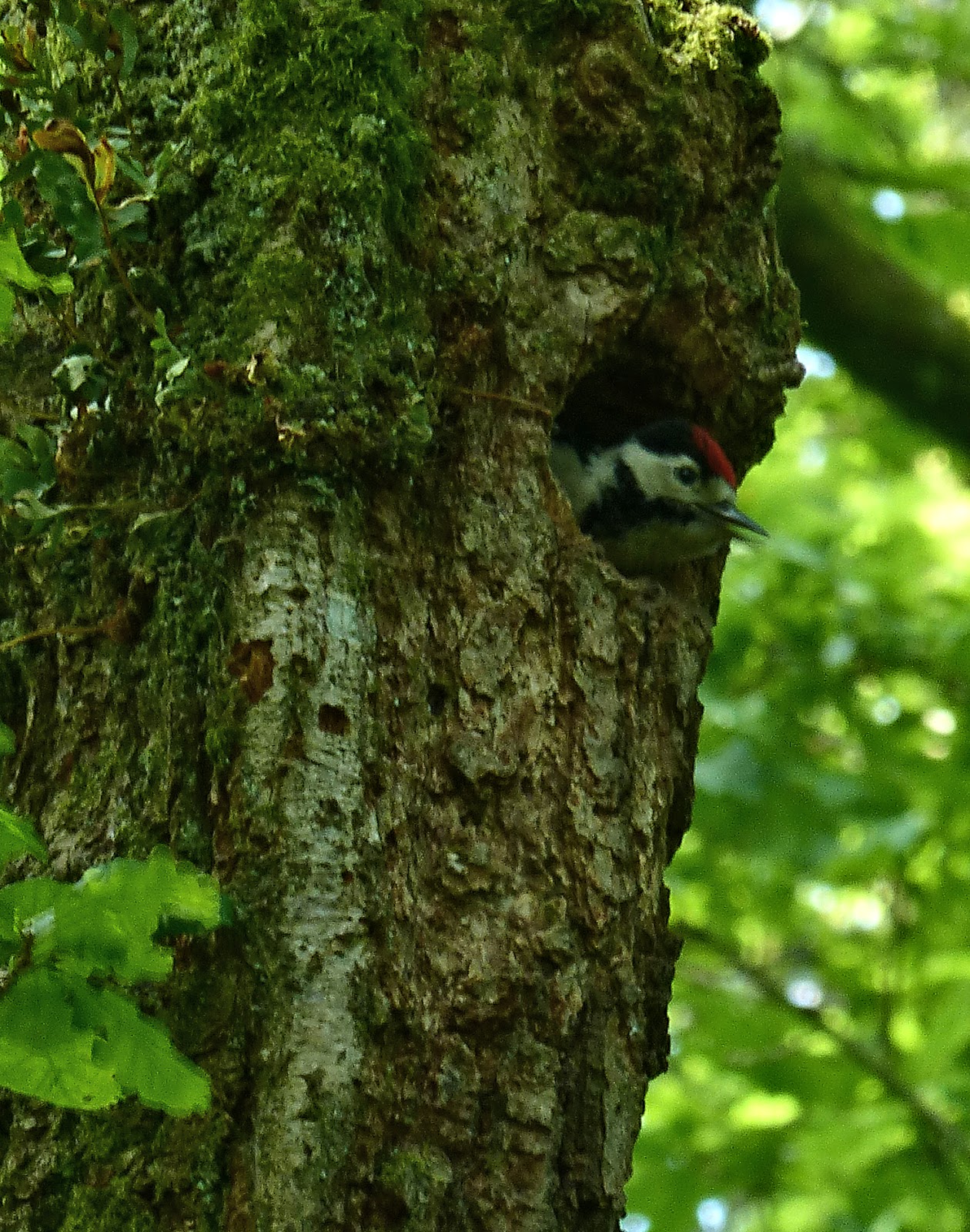
It wasn't just plants, the Horner Valley a few miles east rewarded us birdwise with Pied Flycatcher and Redstarts.  No pictures but did manage to get one of a very hungry Greater Spotted Woodpecker screaming for food!

The only thing we missed on from previous years were butterflies, we were just too early for the Fritillaries of various species including Silver-washed, High Brown and Heath that cruise some of the valleys like small birds in late June and July.  

Exmoor has changed very little in the time I have known it long may it go on.


Friday, 15 April 2016

Of Primulas (and a Violet)

The past few days of warmth and sun has really kick-started spring on Park Downs. The annual blue carpet of Hairy Violet (Viola hirta) has returned and is better than ever, partially as a response to the sheep-grazing this winter but mostly thanks to the Rabbits grazing!  Hopefully this is also good news for the Dark Green Fritillary butterfly (Argynnis aglaja) that seems to be increasing at this site and for which the Violet a larval food plant.


Also increasing are the Cowslips (Primula veris), right, that are just starting to flower and as long as the rabbits do not start nibbling the flower stems they should be spectacular over the next few weeks. In some areas there are so many plants it is impossible not to tread on them if walking through the grass.  Again they benefit from rabbits grazing the sward and increase prolifically from seed.


The Cowslips are early this year and this means their flowering is overlapping with that of the Primroses (P. vulgaris),left, on the slopes of Park Downs.  These are a recent addition to Park Downs flora presumably from seed originating with plants in Banstead Woods where they are increasing nicely. 

 This coincidence of flower which does not happen every year, holds out the hope that over the next few years we may be lucky enough to get some plants of the hybrid between the two, the False Oxlip (P.x polyantha), right, the flowers of which are usually similar to those of Primrose but held in an a multi-flowered umbel similar to Cowslip.  This picture was taken yesterday in "The Hazels" coppice, in Norbury Park, where there is currently the most spectacular display of Primroses as well as a few plants of False Oxlip.


For completion it should be pointed out that False Oxlip is so-named bacause of it's resemblence to Oxlip, a much rarer species of Primula (P.elatior), found mostly in the woods of East Anglia.  I took the picture on the left in March 2014 in Bradfield Woods, Suffolk.

.

Saturday, 12 March 2016

Depressing place!


It is the time of year when IF the sun comes out it is warm and the faint green shoots of spring are beginning to break and birds singing. A time to feel good.

However most days I walk across Park Downs and in doing so walk along the side of the adjacent field to the west of the Downs. What a depressing place, it seems to me to symbolise all that is wrong with agriculture and the causes of the decline in wildlife. At the moment the rotten stubble is waiting for this years crop to be sown. 

Last year it had a cereal crop and as is usual was bombarded with insecticide and herbicide through the season. Following harvest there was an explosion of seed germination, mostly spilt wheat and rape but a few wild flowers including Fumitory, Speedwell and Black Bindweed. This is obviously an anathema to the farming fraternity and so out came the herbicide in October/November to destroy the vegetation. Presumably, a total weedkiller was used and it must be effective because since then nothing (below), I mean nothing, has germinated, even the moss is looking very unhealthy. For all the value to wildlife it has, this field may as well be concrete.   You also have to ask if it's effects have last through the winter, what happens to the run-off?  Not much better, the green in the background is a field of winter cereal that is no doubt due it's first dose of chemicals very soon.

As if poison is not enough, this field has not been ploughed for some years.  Prior to planting the soil is lightly tilled (no soil turning) and then the seed drilled.  Without ploughing it means the surface seed bank is not replenished and with time the diversity of the seed bank will decrease until even the longest-lived seeds are dead, then the field will be able to be ploughed and nothing germinate at all.  Now that would save on herbicide!!  No weeds, no insects (no bees), no birds! 

Elsewhere in the blogosphere Canon's Farm regularly features for its birds, perhaps it is not surprrising that it is usually migrants that provide the interest, after all they have to stop somewhere for a rest!  The only saving grace for the breeding birds is that there are a numbers of copses scattered about the farm (used for shooting) and Banstead Woods is next door that can support some birds.

What is sad is that if you do a little research, all this is common knowledge but such is the power of the agricultural and agrichemical industry nothing gets done about it.

Just to provide a little bit of cheer, cornfield weeds are by a lot of people usually taken to mean the obvious Poppies, Cornflowers etc. but to me most are much less obvious plants typified by one of my favourites, Field Pansy (Viola arvensis), with flowers less than an inch high you have to get down to see them but the effort is worth it!.  This picture was taken along the side of this field a few years ago when it was abundant.  Last summer, with improved spray coverage right up to the edge of the fields there were only a few plants scattered along the field.
  

Friday, 3 July 2015

Corncockle!


While taking the pictures of Kidney Vetch I thought I would also take a few of the "extinct" species that has appeared on Banstead Downs this summer.   About a month ago, I found a couple of plants of Corncockle (Agrostemma githago) growing on a patch of bare chalk. exposed where bonfire ash had been buried.  Corncockle is one of those species, including Poppies and Cornflower, referred to as cornfield weeds, annuals that do not compete well with other species and hence tend to grow on disturbed soil.  Modern agricultural practivce has virtually eradicated them.   It would be nice to think that these plants germinated from seed buried since the Downs were cultivated during WW2 and is a genuine wild plant.  Unfortunately the fact that it was growing very vigorously and associated with equally vigorous Poppy plants suggests that someone may have scattered some "wildflower" seed.  It is a beautiful flower nevertheless.


Amusingly, when I Googled the status of the species on the web, the first pages to come up included this example of newspaper nonsense from last summer.  Equally apparently the BBC Countryfile programme caused a bit of a stir as well!  So sad.

Thursday, 2 July 2015

White Kidney Vetch

A couple of days ago Steve Gale wrote about the remarkable amount of Kidney Vetch on Banstead Downs, it is one of the best years for this seasonal plant for a long time.   However what was all yellow a couple of weeks ago is now pinky-brown, flowering over for the year.... except: whilst walking round the Downs yesterday I noticed a patch that didn't look quite right, it was white-flowered  Kidney Vetch.    

I have seen Kidney Vetch in many shades of yellow and on sea cliffs you can find pink and red forms but I have never seen white before.  

Yesterday when I didn't have a camera the flowers were out but by this morning when I was able to get over there with a camera, they had already started to shrivel, hence the poor pictures, the second shows the comparison with the more normal yellow..  

In all I found two plants!!  But enough for me to get back to blogging... perhaps! 

Thursday, 26 June 2014

Gladdon

A break from rants for a picture of one of my favourite British wildflowers, Gladdon (Iris foetidissima, also known as Wild Iris or Stinking Iris).   Unlike may of its garden cousins the flowers have such subtle colours, a real beauty.


The plant itself is common and easily found along the North Downs but seeing it in flower is more difficult.  It usually has three or four flowers on a stem but usually each only opens for a day especially in hot weather.  I noticed this particular plant growing in dense scrub on Park Downs on Monday with the first bud just opening, by today all but one flower was going over. 

Wednesday, 25 June 2014

What makes me angry, I - Beans!

Not beans as in food but their cultivation, at least in the Banstead area which I suspect is pretty representative of most farms elsewhere.

The picture above shows a growing crop of Broad Beans.  The average gardener would be doing well to have such weed- (and insect-) free rows of plants.  These are however not in a garden or allotment but are part of a large field of the crop in Banstead.  I have been walking the edge of this field for years and this is the culmination of many years application of herbicides to the field until they have successfully eliminated the vast majority of weeds,  the second picture show what is probably the weediest area with just a few plants of a Fumaria sp.

I have addressed this subject before in this blog and expressed my sadness that agricultural success is associated with the loss of all ground cover and my anger that the associated pollution is largely uncontrolled. Such conditions obviously has an impact on the insect population and for those that survive, the recent insecticide application has probably done for them.  It is noticeable that there are few bees pollinating the flowers in this field today.

Of course the response is that we need our farmers to be as efficient as possible in order to produce cheap food for the supermarket or for cattle feed.  I suspect that the majority of the population would agree, again something that saddens me but then I am biased.

BUT this is not enough for farmers and politicians.

A couple of weeks ago the BBC ran this story, it beggars belief!!!  Giving them wildlife conservation grants to allow them to kill plant and insect life destabilize the soil all because the unwitting plants provide a bit of nitrogen into the ground that will save the farmers money on fertilizer.
To requote from the BBC:  "We think including this measure is very positive for the environment" Andrew Clark, NFU.  Well they would wouldn't they?

The whole thing is made worse when you read this sort of report.  Angry, moi?

Tuesday, 10 June 2014

What we have lost, I - House Martins

I live in a bog-standard semi-detached house in the middle of a long row of similar houses in the centre of Banstead, when we moved in thirty years ago I was chuffed to find that our house was blessed with several House Martin nests.  Not only that but most houses in the street had nests and although a few misguided homeowners seemed to enjoy knocking down the nests as the birds were building (they make such a mess you know) most appreciated their presence.   One of the highlights of the year was the anticipation of their reappearance in the spring and summer evenings sitting in the garden were enhanced by watching these birds together with Swifts hawking insects overhead.

Alas no more, the number of nests dwindled over our first ten years here until one spring none appeared, a sad year (around 1992).  I also witnessed a similar pattern around my parents home in south London. Apparently this was a reflection of a much wider decline across much of northern and central Europe since the 70s.

Obviously one wondered why!  To quote from the RSPB page devoted to the species and addressing the decline: "They require rain to produce wet mud for nest building and for encouraging the abundance of insect prey, but cold weather prevents them feeding  Large-scale mortality is regularly recorded during and after periods of bad weather, during both breeding and migration.  On the other hand, hot and dry weather can result in mortality though dehydration and heat stress."  This seems to suggest that climate change may be the important factor.

I had always wondered where they found mud for their nests locally because there was/is precious little surface water or muddy ponds locally but I am not aware that anything has changed there.  In addition, at spring and autumn migration there are still plenty of birds passing through, just not stopping!

My opinion (of course I have to have one) is that their food source (flying insects) has dried up.  Bats, Swifts and Spotted Flycatchers have all shown a similar decline in this area, is it just coincidence that they all have the same diet?

Of course you have to then address the disappearance of insects:  climate change or farming practice? Watch this space!


Can we come out yet?

I had to include a picture of a nest, unfortunately not taken locally but in the Mediterranean where thankfully, there are still large numbers of House Martin and their presence on buildings are more than tolerated and there are still a lot of insects (although that is changing year by year in many places). 


A long time in anger

It is two and a half years since I posted anything here (should remove blog from title).  This is not because I have not been out and about, not because I have had nothing to say but because each time I sat down to write a new entry I became angry!   

I know I have I have reached the age where grumpy is an apt if inadequate description of my state of mind (I find that I can hardly pick up a newspaper without wanting to scream) and so I felt my anger was perhaps a little unjustified and my entries did little to help my condition or anyone who read them and I therefore stopped.

In the intervening period my condition has not changed and my "therapist" tells me that the best way to treat my condition is by expressing the anger and its cause. I have lived in Banstead for over thirty years and in that time much has changed regarding the local wildlife, some things for the better but mostly for the worst.  In addition certain news items recently have really made my blood boil and are so relevant to the title of my blog. Therefore I have decided to use the blog to try and explain my anger and highlight what I think is wrong with the world (especially around Banstead) in the context of natural history!!!  I know there are people out there much more capable than me to do this but who cares.  

I apologise in advance to anyone fed up with rants especially since what follows is likely to be full of ill-informed, poorly-researched personal opinion and hypocrisy.  However it may help my anger and enable me to die a happy man!!  

Saturday, 8 October 2011

Clathrus ruber - science fiction?

Sometimes the natural world throws up sometime totally off the wall and I think that this is the case with Clathrus ruber, a fungus related to the more "normal" Stinkhorns although it bears no similarity in appearance to them.

More like a mockup of a brightly-coloured geodesic dome for use in Dr Who!

My photos were taken this week, in of all places Banstead High Street where it has been appearing roughly at this time each year for at least the past three years on what was originally a pile of wood chippings. I never seem able to capture a perfect mature specimen, the one in the upper picture is starting to autodigest and the other has only just burst out of its"eggskin".

Like Stinkhorns it has a fetid smell and attracts flies as confirmed by the second picture.

Looking it up I find it is a native of the Meditteranean but has been spreading northwards in Europe!Definitely an oddball!

Tuesday, 20 September 2011

Harvest time in Banstead

Tis the "season of mellow fruitfulness" * in north Surrey (and time for my irregular farming rant!) a season we associate with the golden browns of sun-ripened crops!

On Canon’s Farm, to the south of Banstead, the cereal crop was harvested quite a while ago but now it is the turn of the largest crop this year, Flax.

Back in April the fields were prepared for sowing in the traditional way (!), wipe out by spraying with systemic weed killer followed by light cultivation rather than ploughing and then seed drilling. Sadly this included the fields that had been under set aside for many years, these were not even cultivated but the seed drilled directly into the blasted soil.

With our unusually dry early summer, there was considerable variation in germination across the fields and in places the crop is rather sparse compared to some years.

A stroll over the fields two weeks ago showed the tell-tale tractor tracks that indicated that soon it would be harvest time. The fields had again been sprayed with total weed killer, presumably to enable uniform ripening of the seed by ensuring all plants were dead! Within 48h green had disappeared now all is a uniform brown no doubt the crop will be cut in the next few days.

As a townie I know little of good agricultural practice and no doubt those readers with a more rural bent and knowledge will tell me this is the way it is always done. Furthermore that agriculture is a business and this makes it most profitable. However that does not stop my blood from boiling when I see this going on.

Canon’s Farm has been put on the blogging map by Steve Gale and David Campbell as an area that provides excellent birding. However over the past twenty years I have walked the area and seen the demise of most common farmland birds as breeding species in the area, surely at least in part the result of intensive farming causing a lack of a consistent supply of food, seed and insect.

Even without the usual applications of insecticide, fungicide, fertilizer and selective weed killer that cereals get, the use of two applications of total weed killer just five months apart virtually guarantees a reduction in floral diversity that is frightening. Of course this is inevitably followed by a collateral reduction in invertebrates, birds, etc., etc.

I would be less disturbed if the use of chemicals was carried out in a careful manner calculated to minimize the impact, e.g. by the use of buffer zones around the edges of fields etc. Certainly in Banstead this doesn’t happen. The picture on the right shows how much care was taken during the recent attack to ensure spray does not reach the adjacent hedgerow!

I accept that farmers must use the most efficient means possible because they are in business but agriculture as an industry is the only one for which there is little or no policing of pollution from the processes used. A massive amount of chemicals ranging from fertilizers to insecticides are applied to our countryside, the only control being financial. Not only do they casue damage at the point of application but many if not most drain into water courses etc. This is should surely be unacceptable!

Just to add insult to injury and show how much they care, what do they do with the empty containers? Throw them into Banstead woods of course (a SSSI)! The picture on the left shows one they did last year!


* Apologies to Keats

Tuesday, 6 September 2011

Banstead Countryside Day 2011!!!

This year has passed me by! Few posts on the blog, few trips out and not even the chance to follow many blogs or forums! Hopefully however that is about to change and I shall have more time to catch up and indulge.

First job however is to prepare our (BCC) presentation for the Banstead Countryside Day to be held this coming Sunday 11th September and starting at 11.00. This event is organised by the inexhaustible staff and volunteers of the DCMP (Downland and Countryside Management Project) and it truly celebrates the countryside with special focus on the local area.

The Conservators have had a stall since it started, it has got better and better each year and I can guarantee a great day out for everyone. Over the years it has grown but not been commercialised and it remains a local event. It truly celebrates Banstead Countryside.

It costs nothing for entry although I think programmes are for sale (which of course you should buy), for a whole days entertainment that has to be great value.

See you there. Even better come up and have a chat at the Conservators stall!

Thursday, 2 June 2011

Butterfly (Lesser) bonanza

A day out with friends in the New Forest yesterday turned into an unexpected orchidfest. The supposed reason for the visit was to see if, in this early season Wild Gladiolus was out, it wasn't! However at the same time we managed to get some pictures of the white variant of the purple form of Early Marsh Orchid, Dactylorhiza pulchella, although I must admit because of the the problem of photographing white flowers in bright sunshine they were not exactly brilliant. It seemed then that the job was done and socialising was called for!


However on the way to the pub we decided to drop in at a site for Lesser Butterfly Orchid, Platanthera bifolia, just in case there were a few in flower.

There weren't, there were thousands! Scattered over a large area heath growing amongst Ling and Bracken, they were a spectacular sight especially where in places they were also with Heath Spotted Orchid, Dactylorhiza maculata. Lesser Butterfly is not a species I see very often and so for this year when our local orchids have taken such a hammering it was especially satisfying to see.


Tuesday, 31 May 2011

Powder-blue alien!

Work and holidays means I have not had much time to get out and about locally recently and so not had anything to write about.

However that changed yesterday whilst gardening when I happened to spot this little aphid on a leaf! I think it is the craziest thing I have seen in years.

At first I thought it was dead and had been infected with a fungal parasite but once I had got the camera, it naturally started walking away and it took me a while to get a picture. Apparently one of the wings is damaged and I still suspect it has some disease. A quick Google for woolly aphids did not come up with any of this colour and believe me the colour is right.

So: is there anyone out there who knows what it is? If not I will have to post it on the Natural History site, perhaps I'll do that anyway.

I did and it is Phyllaphis fagii (Beech Aphid). Apparently quite common, I shall have to look more closely at the aphids!

Friday, 4 March 2011

Barberry blog

Back to Botany!

The picture below is of the inflorescence from a plant of Common Barberry (
Berberis vulgaris) growing on Park Downs, Banstead. It is a species I had never seen before and is regarded as an archaeophyte in Britain, a long-established alien. It is not particulary common.

Although the individual flowers are small (~1cm diameter) they are rather attractive with the large club-shaped stigma.

On Park Downs it has an interesting/amusing history. A number of plants had been known to be present over many years and it is said that when voluntary conservation work started about 20 years ago they were given the task of clearing scrub to give these plants a bit more space because they were being shaded out. The only trouble was that they didn't appear to be able to separate this species from more common chalk scrub plants and when they finished work they had cleared the lot, Barberry and all. This story is apparently true and it was assumed that the plant was lost from the site.

However last year Roger Hawkins found this individual growing in deep shade that, despite being about 2m tall and having plenty of flower, would be diffcult to find unless you knew where it was. Nice to know at least one survives!

Wednesday, 2 March 2011

Success!!

I am happy to be able to say that the massive campaign I ran on this blog (NOT!!!!) has been successful! (click here)

Seriously, it is great news that the SESWC have decided not to attempt to cross the Heath. It is rather appropriate that the BBC used a Skylark to illustrate their
coverage . A walk over the Heath the other day showed a considerable number of this iconic species taking up territories in areas that would have been reduced to a building site for a year and permanently scarred therefter.

A victory for common sense and a defeat for short-term thinking!

I have learnt a lot over the past few months including some new things about the Heath and its inhabitants. Perhaps I will now have a bit of time to blog about them!

Wednesday, 8 December 2010

Pipeline - the Heath's tale

At present the preferred route (preferred by the water company and local council) for the pipeline would have greatest effect on Banstead Heath, in fact, among other things, cutting it in two for the duration of the work and effectively for a long time after.

Banstead Heath is one of four areas of common land that make up Banstead Commons (the others are Banstead and Park Downs and Burgh Heath), it has an area of approximately 300 hectares (750 acres). The Heath lies on the North Downs between Tadworth roundabout and Walton Heath (also common land but with associated golf course) and just reaches the M25.

The area is heavily used by the local populace for walking with and without dogs and horse riding but surprisingly not many naturalists appear to use it as their local patch, which is a pity. There is a dearth of records for both flora and fauna and the Heath has some real surprises for those bothered to look.

The Heath has existed as common land within its current boundaries (give or take a little) for over five hundred years. At the end of the nineteenth century there was some gravel extraction (which was one of the contributing factors that led to the formation of the Banstead Commons Conservators) but otherwise, until WWII, traditional commoners' practices, cutting wood, grazing etc, meant that it was an open area probably mainly of heather and probably gorse. During WWII a large part was used as a military encampment and some was ploughed. After that the whole area began to scrub up and birch colonisation started. It was not until about twenty years ago that significant management began, aimed at improving the Heath both as an amenity and as wildlife habitat. Since then some dramatic improvements have occurred.

The Heath cannot be described as a place of silence, the proximity of the M25 ensures that, but even in the height of summer, it is possible to find a peaceful spot away from the madding crowd just to enjoy your surroundings.

A number of roads fragment the Heath but apart from a gas pipeline on the south-eastern edge, the main body of the Heath (over 200 hectares) has been untouched by construction, cables and pipes.

JUST the place then to carve up with a pipeline, no thought to history, no thought to users, no thought to wildlife and most important, no guarantee that the pipeline will not cause significant long-term damage to the Heath.

Why? For the water company it will save them a lot of money (mainly because they put no value on the Heath), for the council it seems that they wish to avoid the short-term disruption on the A217 and the associated reaction from the public. Interestingly in the only published test of public opinion (Surrey Mirror online poll in July, not scientific) that I know of, a considerable majority supported the route along the A217 rather than crossing the Heath.

Thursday, 2 December 2010

Pipeline across the Heaths - what value do we put on the countryside?

Following on from the potential damage to Box Hill, another tale of local problems regarding habitat destruction is potentially more serious

Sutton and East Surrey Water Company (SESWC) have declared their intention to install a water main from a reservoir at Mogador, Kingswood to Burgh Heath. They have a fairly simple choice between routing it across 4km of common land mostly on Banstead Heath and Burgh Heath or going down the A217, either in the road or alongside. If they cross the commons they will clear a 20m (yes, ~60ft) swathe along the length of the route to enable the work to take place. Both the water company and the local Council prefer the route across the commons, I wonder why!!

Both Banstead Heath and Burgh Heath are well-used amenity areas for local people but more importantly (as far as I am concerned) are important habitats for both flora and fauna. Construction of the pipeline would cause massive short-term damage and the long-term effects could change the areas irrevocably.

At this point I must declare my interest, as I have been a Banstead Commons Conservator (BCC, I am currently Chairman) for the past 15 years. The BCC manage this area of Commons although most is owned by the local authority and the SESWC require BCC permission to carry out this work. So far this has not been granted!

The whole situation is quite complex, the nature of the Heath, the role of the Conservators, etc. and I aim to address and explain individual aspects over the next few weeks.

I would stress that this blog will be my personal views that may or may not be shared by other conservators.